

MDCAT 2026 Delayed to September New Test Date and Full Schedule
MDCAT 2026 Delayed to September
MDCAT 2026 has officially been delayed, and the examination will now take place on Sunday, 20 September 2026. The Pakistan Medical and Dental Council has confirmed the revised date for students seeking admission to MBBS and BDS programs across Pakistan. The test is expected to begin at 10:00 AM Pakistan Standard Time.
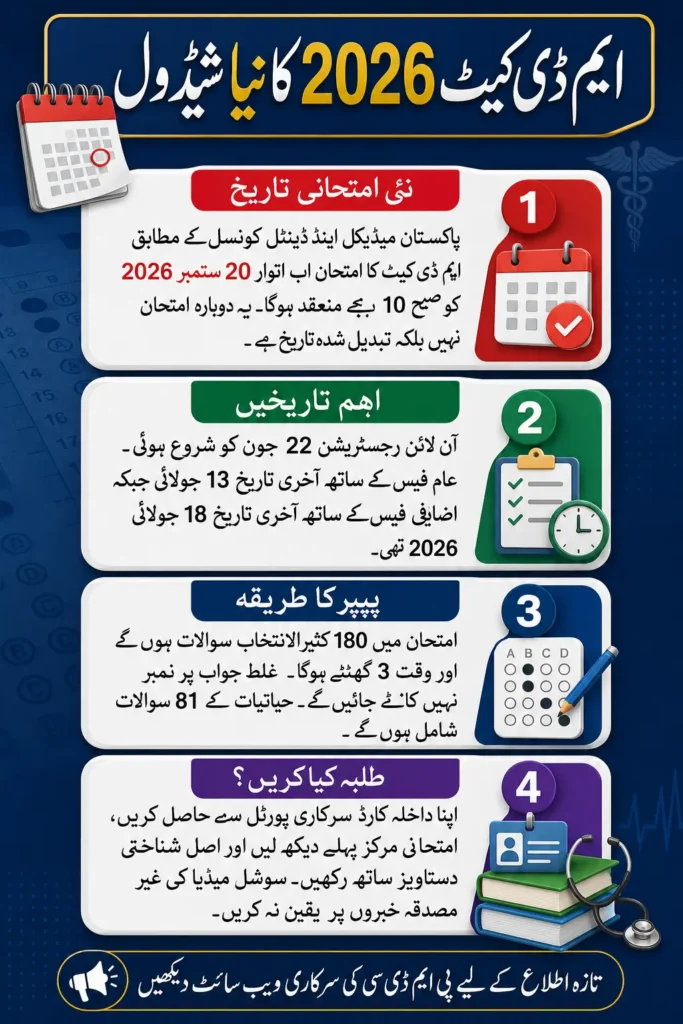
This change gives candidates additional preparation time, but it is important to use it wisely. Students should review the syllabus, practise MCQs and regularly check the PMDC website for admit-card and test-centre updates. PMDC lists the examination as rescheduled, which means this is not a retest. PMDC’s official announcement confirms the new examination date.
MDCAT 2026 New Date and Important Details
The revised MDCAT schedule applies to candidates across Punjab, Sindh, Khyber Pakhtunkhwa, Balochistan, Islamabad and other eligible regions. Although different universities may help conduct the examination in their respective regions, the national test date will remain the same.
According to the official announcement, MDCAT 2026 will be held on 20 September 2026. Students should treat this as their final preparation deadline unless PMDC releases another notification. The important information is given below.
| Information | Details |
|---|---|
| Examination | Medical and Dental College Admission Test |
| Conducting authority | Pakistan Medical and Dental Council |
| Revised test date | Sunday, 20 September 2026 |
| Expected starting time | 10:00 AM PST |
| Test format | Paper-based examination |
| Total questions | 180 MCQs |
| Duration | 3 hours |
| Official registration portal | mdcat.pmdc.pk |
| Official information website | pmdc.pk |
Why Was MDCAT 2026 Moved to September?
PMDC originally announced the examination schedule earlier in 2026. A rescheduling notice was later issued, moving the test to 20 September 2026. The official PMDC website currently displays a public alert informing candidates about this change.
Students should avoid accepting an unofficial explanation for the delay unless it appears in the PMDC notice. Social-media pages sometimes attach their own reasons to schedule changes. Candidates should rely on PMDC’s public announcements page for authentic information.
The revised date means students should:
- Update their study timetable according to 20 September.
- Continue checking the official portal for the admit card.
- Avoid relying on screenshots without an official link.
- Keep their application and fee-payment records safe.
- Confirm their test centre before examination day.
Is the September Examination a Retest?
The September examination should not be described as a retest. A retest normally takes place when an examination has already been conducted and must be held again because of cancellation, a legal decision, a paper leak or another serious issue.
In this case, PMDC has changed the original schedule before the examination was held. Therefore, the correct terms are MDCAT 2026 rescheduled, MDCAT postponed, or MDCAT delayed to September. Using the right wording prevents unnecessary confusion among students and parents.
Who Needs to Appear in MDCAT 2026?
MDCAT stands for the Medical and Dental College Admission Test. It is an important entry test for students who want to seek admission to MBBS or BDS programs in Pakistan. Candidates applying to participating public and private medical or dental colleges must meet the relevant MDCAT and academic requirements.
Passing the examination does not automatically secure a medical-college seat. Admission is based on the candidate’s aggregate, merit position, applicable provincial policy, available seats and other conditions announced by the relevant admission university.
MDCAT candidates generally include:
- FSc Pre-Medical students seeking MBBS admission.
- Students applying for BDS programs.
- Candidates with an accepted equivalent qualification.
- O-Level and A-Level students holding an IBCC equivalence.
- Previous candidates who want to improve their admission chances.
MDCAT 2026 Registration Timeline
Online registration for MDCAT 2026 opened on 22 June 2026. The regular application period closed on 13 July 2026, while applications with a late fee were accepted until 18 July 2026.
These registration windows have now closed according to the supplied schedule. A student who missed both deadlines should not assume that an application can still be submitted. Another chance will only be available if PMDC officially reopens or extends registration.
| Registration Event | Date |
|---|---|
| Online applications opened | 22 June 2026 |
| Regular-fee deadline | 13 July 2026 |
| Late-fee deadline | 18 July 2026 |
| Admit card | Before the examination |
| Revised examination date | 20 September 2026 |
How Candidates Registered Online
The application process was completed through the official MDCAT portal at mdcat.pmdc.pk. Candidates were required to create an account, submit their personal and academic information, upload supporting records and pay the prescribed fee.
Applicants should now keep their login details available. The same portal may be used to check the application, obtain the roll-number slip or download the admit card when it becomes available.
The online application method included these steps:
- Visit
mdcat.pmdc.pk. - Create a candidate account or sign in.
- Enter personal and contact details.
- Provide Matric and FSc academic information.
- Select the permitted test city.
- Upload clear copies of the required records.
- Generate the fee challan.
- Pay the prescribed amount through the available channel.
- Review and submit the completed form.
- Save the application and payment receipt.
Documents Required for the Application
Candidates were expected to upload accurate identity and educational records. A spelling difference between the application, CNIC and academic certificates may create difficulty when the admit card or candidate record is checked.
The photograph and scanned documents should be clear enough to read. Students with foreign qualifications must also fulfil equivalence requirements before their documents can be accepted for admission purposes.
The commonly required documents included:
- Valid CNIC or B-Form.
- Recent passport-size photograph.
- Matric certificate or marks sheet.
- FSc Pre-Medical certificate or marks sheet.
- Domicile certificate.
- Juvenile Registration Certificate where applicable for an under-18 candidate.
- IBCC equivalence certificate for O/A-Level or foreign qualifications.
Registration Fee for Pakistani and Overseas Centres
According to the information provided for MDCAT 2026, the regular fee for a test centre in Pakistan was Rs.9,000, while the late fee was Rs.13,000. International candidates had a separate fee structure.
The reported fee was non-refundable and non-transferable. Candidates should preserve their paid challan or digital transaction receipt because it may be needed if the payment is not immediately reflected in the application account.
The listed charges were:
- Pakistani test centre regular fee: Rs.9,000
- Pakistani test centre late fee: Rs.13,000
- International centre regular fee: Rs.45,000
- International centre late fee: Rs.55,000
Eligibility Conditions for MDCAT Applicants
The supplied eligibility information states that candidates need at least 60% marks in HSSC, FSc Pre-Medical or an accepted equivalent qualification. Biology and Chemistry are required subjects, along with Physics or Mathematics under the applicable criteria.
Students with Cambridge or another foreign qualification require an equivalence certificate from IBCC. Candidates should remember that sitting MDCAT and qualifying for final college admission are separate matters. Medical colleges may apply additional merit and document conditions.
The key eligibility points include:
- At least 60% marks in HSSC or equivalent.
- Biology and Chemistry as compulsory subjects.
- Physics or Mathematics under the relevant rules.
- Valid CNIC, B-Form or other accepted identity record.
- IBCC equivalence for foreign qualifications.
- No stated age limit under the supplied criteria.
- No stated restriction on the number of attempts.
Domicile and Test-Centre Rules
MDCAT is conducted on a common national date, but candidates generally apply under their province or region of domicile. Medical and dental admissions are later managed through the concerned provincial or regional authority.
Candidates should carefully check the test centre shown on their admit card. A selected city may not be changeable after the application is submitted. No student should travel to a different city based only on an old application screenshot.
The relevant regional bodies commonly include:
- Punjab: University of Health Sciences
- Sindh: DUHS or JSMU, according to the notified arrangement
- Khyber Pakhtunkhwa: Khyber Medical University
- Balochistan: Bolan University of Medical and Health Sciences
- Islamabad/Federal region: Shaheed Zulfiqar Ali Bhutto Medical University
- Azad Jammu and Kashmir: Authority notified for the AJK region
MDCAT 2026 Admit Card Download
The admit card is one of the most important documents for examination day. It usually includes the candidate’s roll number, test-centre address, reporting time and instructions. Students should download it from the official portal as soon as PMDC makes it available.
After downloading the document, candidates should read every entry carefully. If there is a serious error in the name, photograph or other identifying information, it should be reported through the official support channel before the examination.
Check the following details on the admit card:
- Candidate’s full name.
- CNIC or B-Form information.
- Roll number.
- Candidate’s photograph.
- Examination city and centre.
- Reporting and starting time.
- Permitted stationery.
- Prohibited items and test instructions.
MDCAT 2026 Paper Pattern
The supplied examination format contains 180 multiple-choice questions to be attempted within three hours. The paper is expected to be conducted in English through a physical OMR answer sheet. One mark is awarded for a correct response, with no negative marking under the stated scheme.
Biology carries the largest share of the paper. Candidates should give it appropriate preparation time without ignoring Chemistry and Physics, which together account for a substantial portion of the test.
The subject distribution is:
- Biology: 81 MCQs
- Chemistry: 45 MCQs
- Physics: 36 MCQs
- English: 9 MCQs
- Logical Reasoning: 9 MCQs
- Total: 180 MCQs
Passing Marks for MBBS and BDS
The stated passing percentage is 55% for MBBS and 50% for BDS. In a 180-question paper, this equals 99 correct answers for the MBBS threshold and 90 correct answers for BDS.
However, obtaining the minimum score only makes a candidate eligible under that part of the admission criteria. Public medical colleges usually have high merit levels, so students should aim well above the minimum passing score.
Candidates should keep these targets in mind:
- MBBS passing threshold: 55%
- MBBS equivalent score: 99 out of 180
- BDS passing threshold: 50%
- BDS equivalent score: 90 out of 180
- Final admission: Subject to aggregate and merit
How to Use the Extra Preparation Time
The revised date can benefit candidates who previously felt unprepared. Instead of changing books repeatedly, students should identify weak chapters and build a realistic daily plan. In my experience of reviewing examination schedules, students benefit more from consistent practice than from an unrealistic timetable made only for a few days.
A good plan should include concept revision, chapter-based MCQs and timed full-paper practice. Candidates should also leave enough time to study their mistakes after each mock test.
A practical weekly routine may include:
- Revise Biology daily because it carries 45% weight.
- Divide Chemistry into physical, organic and inorganic sections.
- Practise numerical questions from Physics.
- Solve short English and logical-reasoning exercises.
- Attempt one complete 180-question mock test every week.
- Review every incorrect answer after the test.
- Practise filling an OMR sheet within the given time.
Mistakes Students Should Avoid
One common mistake is collecting too many books, notes and online lectures without completing any single resource. Another is delaying mock tests until the final week. A student may understand every chapter but still struggle if they have never attempted 180 questions under time pressure.
Candidates must also stay away from fake date sheets and unofficial admit-card links. Personal information such as CNIC numbers and passwords should only be entered on the official portal.
Avoid these mistakes during preparation:
- Ignoring the latest PMDC syllabus.
- Depending on unconfirmed social-media updates.
- Using several conflicting preparation resources.
- Skipping full-length mock papers.
- Spending too much time on one difficult question.
- Failing to practise OMR-sheet marking.
- Studying all night immediately before the test.
Instructions for Examination Day
Candidates should locate their examination centre at least one day before the test. On the morning of 20 September 2026, they should leave home early because traffic, security checks and large crowds can cause delays.
Carry only the documents and stationery permitted in the official instructions. Mobile phones, smartwatches and other electronic devices may be prohibited inside the centre. The final instructions printed on the admit card should take priority over general advice found online.
Before leaving home, check:
- Printed MDCAT admit card.
- Original CNIC, B-Form or required identification.
- Permitted writing material.
- Test-centre address.
- Reporting time.
- Transport arrangement.
- PMDC instructions regarding prohibited items.
Final Words
MDCAT 2026 has been rescheduled to Sunday, 20 September 2026, giving candidates more time to revise before the national medical and dental entry test. Registration opened on 22 June and the late-fee window ended on 18 July 2026.
Students should now focus on preparation, admit-card updates and examination-day arrangements. Check the official PMDC website regularly because any further change will only be considered authentic when announced by the council.
Frequently Asked Questions
When will MDCAT 2026 be held?
PMDC has rescheduled MDCAT 2026 to Sunday, 20 September 2026. The supplied schedule states that the examination will begin at 10:00 AM PST.
Has MDCAT 2026 been cancelled?
No. It has been delayed and assigned a new date. Candidates should continue their preparation for the September examination.
Is MDCAT 2026 being conducted as a retest?
No. The September paper is a rescheduled examination, not a retest, because the original test had not already been conducted.
How many questions will be included?
The stated paper pattern contains 180 multiple-choice questions covering Biology, Chemistry, Physics, English and Logical Reasoning.
Is there negative marking?
No negative marking is mentioned in the supplied MDCAT 2026 pattern. A correct answer carries one mark, while an incorrect answer carries zero.
What are the MDCAT 2026 passing marks?
The stated minimum is 55% or 99 out of 180 for MBBS and 50% or 90 out of 180 for BDS. Passing does not guarantee admission.
Where can candidates download their admit cards?
Candidates should sign in to the official application portal at mdcat.pmdc.pk. They should not download an admit card from an unofficial website.
Can the selected test city be changed?
The supplied rules indicate that a city selected during registration may not be changeable. Candidates should follow the centre mentioned on their official admit card.
Can O-Level and A-Level students apply?
Yes, subject to the applicable requirements. Such students normally need an IBCC equivalence certificate for their foreign or Cambridge qualifications.
Which website should students follow for new notices?
Students should check the official PMDC website at pmdc.pk and the MDCAT application portal rather than relying only on social-media posts