KP Launches Door-To-Door Survey For Out-Of-School Children Full Details 2026
KP Launches Door-To-Door Survey
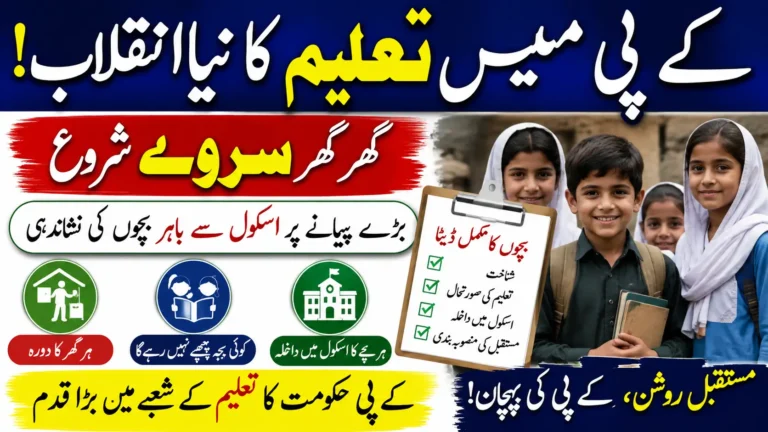
Khyber Pakhtunkhwa has started a major education-focused initiative to identify children who are currently not attending school. Under the new plan, government teams will conduct a door-to-door survey across the province to find out how many children are out of school, where they live and what factors are keeping them away from education.
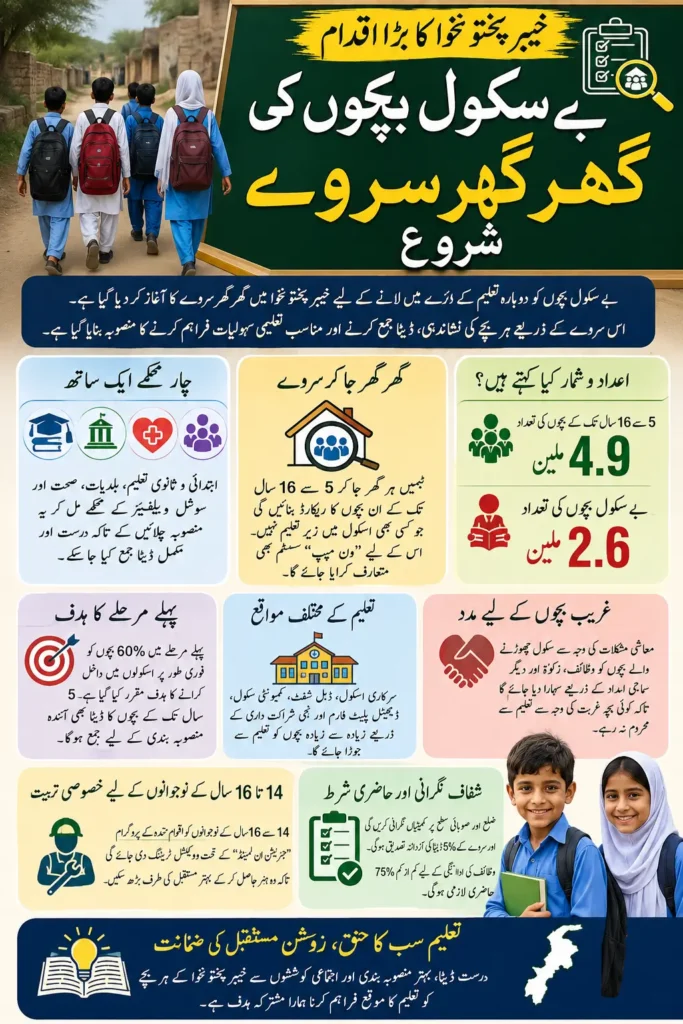
The initiative is aimed at turning this information into practical action. Instead of relying only on existing records, officials will collect information directly from households. The government plans to use the data to enrol a large number of children, expand available learning options and provide financial support to families facing economic difficulties.
You Can Also Read: Wifaq-ul-Madaris Announces Annual Exam Fee
Why KP Has Started the New Education Survey
The main reason behind the survey is the large number of children who are believed to be outside the education system. Government officials need accurate information about these children before they can plan schools, teachers, scholarships and other educational facilities according to actual local needs.
The door-to-door approach is expected to provide a clearer picture at the household level. It can help officials identify children who may not appear correctly in existing school records, particularly in communities where poverty, distance, lack of facilities or other family circumstances affect school attendance.
The initiative will focus on several important areas:
- Identifying children who are not attending school.
- Recording where out-of-school children are living.
- Understanding the scale of the education gap in different areas.
- Supporting future school and education planning.
- Helping the government develop targeted enrolment strategies.
By collecting information directly from families, the provincial government hopes to move from estimates toward more organised and usable data.
You Can Also Read: KP Clarifies Viral Summer Vacations Extension
Four Departments Join Hands for the Province-Wide Drive
The project will not be handled by the education department alone. Four provincial departments will work together so that information about children and their families can be collected and used more effectively.
The Elementary and Secondary Education Department will have a central role because the ultimate objective is to bring children into education. The Local Government Department can support the field-level work, while the Health and Social Welfare departments can contribute information relevant to children and families.
The departments involved are:
| Department | Expected Role |
|---|---|
| Elementary and Secondary Education | Education records, enrolment and school planning |
| Local Government | Local-level coordination and field support |
| Health Department | Relevant child and household information |
| Social Welfare Department | Support for vulnerable families and children |
The plan was formally finalised through a memorandum of understanding signed in the presence of Chief Minister Sohail Afridi. The involvement of multiple departments indicates that the government wants the survey to become a coordinated provincial effort rather than a limited education department exercise.
Door-To-Door Data Collection Across Khyber Pakhtunkhwa
Under the initiative, officials will conduct a comprehensive survey by visiting households. The purpose is to identify children who are not attending school and record the information needed to understand their situation.
A door-to-door survey can be particularly useful in areas where official records do not fully reflect the number of children living in a community. Field teams can collect information directly from parents and households and identify children who need an education opportunity.
The government also plans to introduce a “One Map” system. This system is expected to help organise information geographically so that authorities can better understand where out-of-school children are concentrated.
This type of mapping can help officials answer practical questions such as:
- Which areas have the highest number of out-of-school children?
- Where is additional school capacity needed?
- Which communities may benefit from alternative education options?
- Where should future education resources be focused?
The value of the survey will ultimately depend on the accuracy of the information collected and how effectively the government uses it after the fieldwork is completed.
You Can Also Read: KP Boards Announce 2nd Annual Exam Dates 2026
What the Latest Figures Reveal About School-Age Children
The figures shared in the briefing show the size of the challenge facing Khyber Pakhtunkhwa’s education system. According to the 2023 census, approximately 4.9 million children between the ages of 5 and 16 are living in the province.
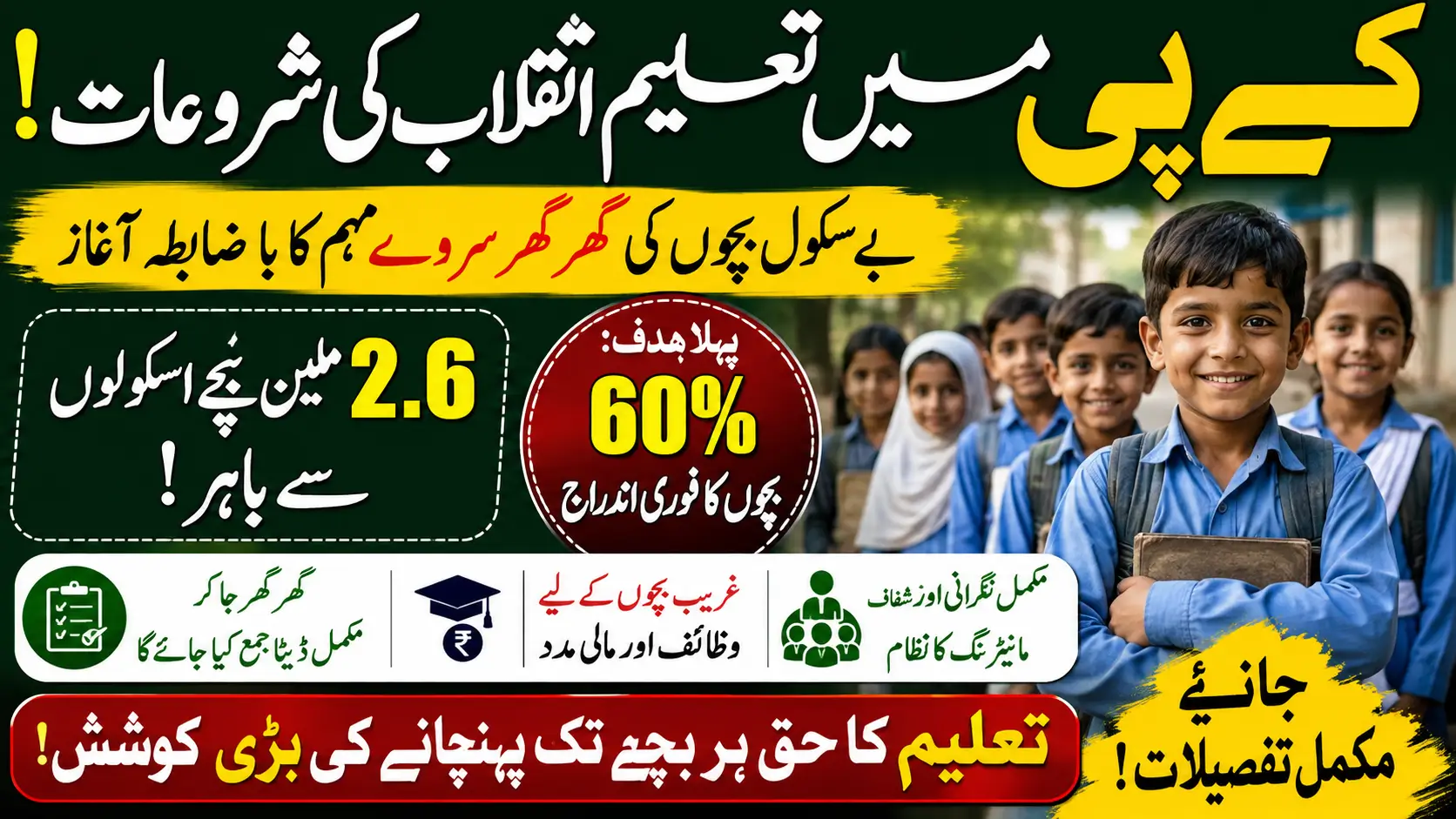
At the same time, the education department estimates that around 2.6 million children in this age group are not attending school. This means the province is dealing with a very large education gap that cannot be addressed through a single measure.
| Education Indicator | Reported Figure |
|---|---|
| Children aged 5–16 in KP | Around 4.9 million |
| Estimated out-of-school children | Around 2.6 million |
| First-phase enrolment target | 60% of out-of-school children |
| Independent data verification | 5% of surveyed data |
| Scholarship attendance requirement | At least 75% |
These numbers also explain why the government is focusing on detailed data collection. If officials know the exact locations and circumstances of children who are out of school, resources can potentially be directed toward the communities that need them most.
You Can Also Read: Joinpakarmy.gov.pk Jobs Online Apply
First-Phase Target: Bringing 60% of Children Into Education
The provincial government has set an ambitious initial target of enrolling 60% of the children identified as being out of school. The first phase will therefore focus not only on counting children but also on connecting them with suitable education opportunities.
The survey data can help authorities decide which option is most practical for a particular child. For some children, a nearby government school may be the right choice. Others may need access to community-based learning, double-shift classes or digital education.
The government also plans to collect information about children up to five years old. Although these younger children may not yet be part of the main school-age target, their information can help authorities prepare for future demand and plan educational facilities in advance.
Different Education Options for Children Who Are Out of School
The government is planning to use more than one method to accommodate children who are currently outside the education system. This is important because the reasons for being out of school can vary from one community to another.
Government schools will remain an important part of the plan, but additional arrangements are also being considered. Double shifts can allow existing school buildings to accommodate more students, while community schools can provide an option in areas where access to conventional schools is difficult.
The proposed education channels include:
- Government schools.
- Double-shift schooling.
- Community schools.
- Digital learning platforms.
- Partnerships with private institutions.
This flexible approach could help the province deal with different local conditions. A single education model may not work equally well in urban centres, rural communities and areas where schools are already operating near their capacity.
Financial Support for Children Facing Poverty
Poverty is one of the issues being considered under the initiative. Some children may leave school because their families cannot afford education-related expenses or because they need to contribute to household income.
For such families, simply identifying an out-of-school child may not be enough. The government plans to connect eligible children with scholarships, Zakat and other forms of social assistance so that financial problems do not permanently keep them away from education.
The support is intended to make it easier for vulnerable families to keep their children enrolled. The approach also recognises that education and household financial conditions are often closely connected.
You Can Also Read: MDCAT 2026 Delayed to September
Financial assistance may be particularly important for families that struggle with:
- Education-related expenses.
- Household financial pressure.
- Children leaving school because of economic hardship.
- The cost of maintaining regular attendance.
The success of this part of the programme will depend on identifying deserving families and ensuring that support reaches them through a transparent process.
Vocational Training Plan for Teenagers
The government is also taking a different approach for older children. Teenagers between 14 and 16 years of age will be considered for vocational training under the United Nations programme Generation Unlimited.
For some older children who have already been away from school for a considerable period, returning directly to a traditional classroom may be difficult. Vocational training can provide an alternative route by giving them practical skills that can be useful in their future working lives.
The focus on skills is especially relevant for teenagers who need an education pathway that combines learning with practical preparation. The programme could therefore become an important part of the wider effort to reduce the number of young people who remain disconnected from both education and skills development.
How the Government Will Monitor the Programme
A project of this size requires a system to check whether the work is being carried out correctly. For this reason, provincial and district-level steering committees will monitor the initiative.
These committees are expected to follow progress and help coordinate implementation at different administrative levels. Their involvement can also make it easier to identify problems during the survey and enrolment stages.
The government has also planned independent verification of 5% of the surveyed data. This means a separate body will check a portion of the information collected to improve transparency and confidence in the results.
The monitoring framework will focus on:
- Provincial-level oversight.
- District-level monitoring.
- Verification of 5% of surveyed records.
- Tracking of enrolment progress.
- Monitoring of scholarship-related attendance.
Independent checking is particularly important because the quality of the final education plan will depend heavily on the accuracy of the original survey.
Attendance Requirement for Scholarship Payments
The government has linked scholarship payments with school attendance. Children receiving scholarships will be required to maintain at least 75% attendance.
This condition is intended to encourage regular participation after enrolment. Bringing a child into school is only the first step; keeping that child connected with education is equally important.
The attendance requirement can also help ensure that financial support is being used as part of a wider education objective rather than simply being treated as unconditional assistance.
For families receiving scholarship support, the key point is that:
- The child must remain enrolled.
- Regular school attendance will be monitored.
- At least 75% attendance is required.
- Scholarship payments will be linked with this attendance condition.
A system that combines financial support with attendance monitoring could help the government measure whether children are actually continuing their education after being enrolled.
Expected Impact on Education Planning in KP
The door-to-door survey could provide the provincial government with a much more detailed understanding of the education situation across Khyber Pakhtunkhwa. Instead of looking only at province-wide figures, authorities will have the opportunity to identify specific communities where children are missing from schools.
The information can also support future decisions about where new schools, additional classrooms and alternative education programmes may be needed. Collecting data about younger children could further help authorities estimate future enrolment requirements before pressure on existing schools becomes more serious.
The long-term impact will depend on what happens after the survey. Accurate data alone cannot bring children back to classrooms. It must be followed by practical enrolment opportunities, financial support where necessary, suitable learning facilities and regular monitoring.
If implemented effectively, the initiative could help KP move toward a more data-driven education system where resources are directed according to actual needs. The immediate target of enrolling 60% of identified out-of-school children represents a significant challenge, but the province-wide survey provides a starting point for understanding the problem more clearly and planning a practical response.